The Melting point of ice is 32 F or 0 C or 273 K. The temperature of the reverse change from liquid to solid is called the freezing point or crystallization point. For most substances the melting pointand freezing points are equal. For ice, the melting point is 0°C or 273K..
Beside this, what is the melting point of ice?
At temperatures above 32°F (0°C), pure water ice melts and changes state from a solid to a liquid (water); 32°F (0°C) is the melting point. For most substances, the melting and freezing points are about the same temperature.
Also Know, what is the boiling point of ice? Ice is a solid, thus in order to reach it's boiling point with no change in molecular structure, it will need to pass through water (liquid). Thus it's 100°C at 1 ATM pressure. But if we are to talk about Triple Point, the triple point of pure water is at 0.01°C (273.16K, 32.01°F) and 4.58 mm (611.2Pa) of mercury .
Thereof, why is the melting point of ice low?
Actually, if you start out with ice at say 0° C (32°F) and sprinkle some salt on it, it will start to melt. Melting soaks up heat ("latent heat") because the liquid has more energy than the solid. That cools the ice and the salty water to less than 0°C. So yes, it does lower the actual temperature.
Does snow melt at 0 degrees?
Snow forms when the atmospheric temperature is at or below freezing (0 degrees Celsius or 32 degrees Fahrenheit) and there is a minimum amount of moisture in the air. If the ground temperature is at or below freezing, the snow will reach the ground.
Related Question Answers
Can you add milk to melted chocolate?
Melt Chocolate with Liquids Method:Chocolate can be safely melted with a small amount of liquid, such as milk, cream, butter, or alcohol if they are placed in the pan or bowl together (the same time). Cold liquids should never be added to melted chocolate, as they can cause the chocolate to seize.At what temperature does Diamond melt?
4892 degrees Fahrenheit
What liquids dont freeze?
There are no liquids that do not freeze.Such a substance is called a supercooled liquid. The temperature at which a liquid freezes under atmospheric pressure is called the normal freezing point.Is there a highest temperature at which ice can exist?
0°C is the highest temperature of pure ice (H2O) -- the hottest it can normally get -- so yes, it can be colder.How cold is dry ice?
-109.3°F
What is the melting point of dry ice?
Dry ice is the frozen form of carbon dioxide, which is why, instead of melting into a liquid when heated, it turns into a gas. As it sits at an exceptionally cold temperature of -109.3°F, handling it properly is a top priority.What element has the highest boiling point?
Tungsten
Does salt water melt slower?
No, salt water does not (in that situation) seem to melt slower. Then, if you supply outside heat, the water will quickly warm to 0 C, and then slowly melt. The water plus salt will start to melt at a lower temperature, as you suggest. Since it starts to melt colder, heat will flow into it more quickly.Does salt make ice colder?
When salt is added to the ice bath (usually rock salt in ice cream making), it comes into contact with the thin layer of water on the surface of the melting ice. This salt water has a lower freezing point, so the temperature of the ice bath can get even colder, thus freezing the ice cream more quickly.Does salt increase boiling point?
Salt increases water's boiling point, or the temperature it must reach in order to boil. This new salt water solution needs more heat to start boiling than pure water does, so the time it takes to boil increases slightly. So your water is hotter, but it's not boiling any faster.Can a gas melt?
What does the melting point of a gas mean? The MP of a gas makes perfectly good sense. It is the temperature when the solid phase of a gas changes to a liquid phase of the gas. And, as you would expect, the Boiling point is the point when the liquid form of the gas changes to the vapor phase.How Does salt cause freezing point depression?
When added to ice, salt first dissolves in the film of liquid water that is always present on the surface, thereby lowering its freezing point below the ices temperature. Ice in contact with salty water therefore melts, creating more liquid water, which dissolves more salt, thereby causing more ice to melt, and so on.Does salt melt ice?
Salt Lowers the Freezing PointIn a nutshell, salt is a great ice melter because it causes “freezing point depression.” This means that salt helps in lowering the freezing point and, consequently, the melting point of water (the main component of snow and ice). In its pure state, water freezes at 0°C or 32°F.What temp does salt water freeze?
Fresh water freezes at 32 degrees Fahrenheit but seawater freezes at about 28.4 degrees Fahrenheit , because of the salt in it. When seawater freezes, however, the ice contains very little salt because only the water part freezes. It can be melted down to use as drinking water.What is I in freezing point depression?
Freezing-point depression is the decrease of the freezing point of a solvent on the addition of a non-volatile solute. Examples include salt in water, alcohol in water, or the mixing of two solids such as impurities into a finely powdered drug.What is melting point of solid?
The melting point (or, rarely, liquefaction point) of a substance is the temperature at which it changes state from solid to liquid at atmospheric pressure. At the melting point the solid and liquid phase exist in equilibrium.What is Class 9 boiling point?
NCERT Class 9 Science Lab Manual – Melting Point of Ice and Boiling Point of Water. Boiling Point: The temperature at which the liquid boils and changes into gaseous state at the atmospheric pressure is called boiling point. For example, water boils at 100°C to form water vapour (at 76 cm pressure).What is melting point and boiling point?
The boiling point is the temperature at which a material changes from a liquid to a gas (boils) while the melting point is the temperature at which a material changes from a solid to a liquid (melts). Keep in mind that a material's melting point is the same as its freezing point.What elevation does water freeze?
Decreasing altitude increases atmospheric pressure which causes water to boil at increasingly higher temps, whereas the freezing point remains somewhat constant, until about 632.4 mpa where the freezing temp starts rising significantly, staying frozen at 100° C @2.216 GPa (and continuing slightly upwards, even 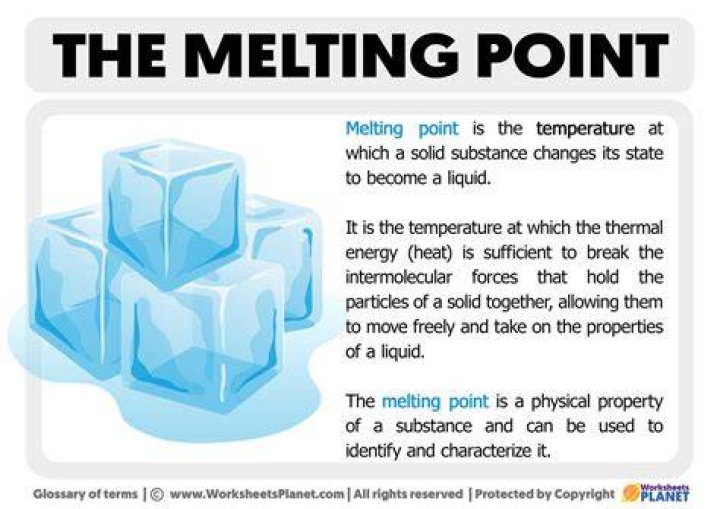
 Lily Fisher