To date, two distinct mechanisms of cell death have been recognized: necrosis and apoptosis. Necrosis is associated with the disruption of the cell membrane, resulting in a loss of cytoplasm, and, finally, a random nuclear degradation..
People also ask, what is cell injury in pathology?
Cell damage (also known as cell injury) is a variety of changes of stress that a cell suffers due to external as well as internal environmental changes. Cell damage can be reversible or irreversible. Depending on the extent of injury, the cellular response may be adaptive and where possible, homeostasis is restored.
One may also ask, how do cells respond to injury? Cellular damage causes a severe inflammatory response that ends with repair to damaged cells/tissue, and is part of the innate immune response. Following injury, the damaged endothelium releases mediators and stimulates the clotting cascade. The IR and the damaged endothelium work together.
Secondly, how does cell injury occur?
Cell Injury. Cell damage can occur as a result of an adverse stimulus which disrupts the normal homeostasis of affected cells. Among other causes, this can be due to physical, chemical, infectious, biological, nutritional or immunological factors.
What is the most common cause of cellular injury?
Hypoxia is the most important cause of cell injury.
Related Question Answers
What are the types of cell injury?
There are two types of cell death, necrosis and apoptosis, which differ in their morphology, mechanisms, and roles in disease and physiology. The cellular response to injurious stimuli depends on the type of injury, its duration, and its severity.What are the major causes of cell injury?
Extremely important common cause of cell injury/cell death. Causes include reduced blood flow (ischemia), inadequate oxygenation of the blood, decreased blood oxygen-carrying capacity.What is the most common type of cell injury?
Mechanisms of ischemic/hypoxia cell deathIschemic injury, i.e. reduced blood flow, is the most common type of injury in clinical medicine.What happens when the cell wall is damaged?
Damage to the cell wall disturbs the state of cell electrolytes, which can activate death pathways (apoptosis or programmed cell death). They also play an important role in the elimination of damaged cells, such as those irreversibly injured by environmental or antibiotic stress.Can damaged cells be repaired?
Like Apollo 13, a damaged cell cannot rely on anyone to fix it. It must repair itself, first by stopping the loss of cytoplasm, and then regenerate by rebuilding structures that were damaged or lost. Understanding how they repair and regenerate themselves could guide treatments for conditions involving cellular damage.What is cell death called?
If cells are no longer needed, they commit suicide by activating an intracellular death program. This process is therefore called programmed cell death, although it is more commonly called apoptosis (from a Greek word meaning “falling off,” as leaves from a tree).What is cell repair?
Cell injury is the process through which a cell is damaged and start to behave in a different manner, in some cases with negative influence to the rest of the cells and organs. The repair mechanism of a cell that was damaged is the mechanism that the cell has to restore its normal function.What is cell injury and adaptation?
When cells are injured, one of two patterns will generally result: reversible cell injury leading to adaptation of the cells and tissue, or irreversible cell injury leading to cell death and tissue damage. When cells adapt to injury, their adaptive changes can be atrophy, hypertrophy, hyperplasia, or metaplasia.How do cells repair?
This happens when DNA building blocks are swapped or changed around, or where one or both strands of DNA is torn. When damage occurs, the cell sends repair proteins to the spot to quickly resolve it. In the process of repairing itself, it may be destroyed or converted to a cancer cell.What is reperfusion injury?
Other names. Reperfusion insult. Specialty. Cardiology. Reperfusion injury, sometimes called ischemia-reperfusion injury (IRI) or reoxygenation injury, is the tissue damage caused when blood supply returns to tissue (re- + perfusion) after a period of ischemia or lack of oxygen (anoxia or hypoxia).What happens to cells of injured tissue?
Basically what happens when a tissue is damaged is that the cells on the affected part degenerate. It so happens that they release hydrolysis enzyme which digests other cells surrounding that particular area. The cell of the injured tissue can also cause these cells to die or what is also known as the lethal injury.What happens if the cell membrane is damaged?
If the cell membrane is unable to do its job properly, this can cause the cell to stop working properly. If many cells have bad cell membranes, the disease can affect an entire organ or even the whole body. In many of these cell membrane diseases, proteins within the cell membrane don't transport materials properly.What would happen if a cell's chromatin were damaged?
3. If a cell's chromatin were damaged, the cell would a. swell up and burst.Is Karyorrhexis reversible?
KARYOLYSIS: Irreversible cell death characterized by lysing of nucleus, due to action of DNAase and RNASE. KARYORRHEXIS: Irreversible cell death characterized by fragmentation of the nucleus. PYKNOSIS: Irreversible cell death characterized by condensation of the nucleus and clumping of chromatin.What is reversible cell injury?
Reversible Cell Injury. Cell Injury. REVERSIBLE CELL INJURY (RCI): If ischemia or hypoxia is for short period of time, the cell can be reverting back to its normal condition which is known as RCI. In coronary arteries, myocardial contractility is reversed if circulation is quickly restored.What is the difference between reversible and irreversible cell injury?
Difference Between Reversible and Irreversible Cell Injury. Cell injury may be a reversible or irreversible process. In reversible cell injury, cells can recover to their normal function. In irreversible cell injury, cells undergo injury so severe that cell death and, ultimately, necrosis of tissue occur.What a cell is?
The cell (from Latin cella, meaning "small room") is the basic structural, functional, and biological unit of all known organisms. A cell is the smallest unit of life. Cells consist of cytoplasm enclosed within a membrane, which contains many biomolecules such as proteins and nucleic acids.What are the four types of cellular adaptation?
Overview: The four basic types of cellular adaptation to be discussed in this section are hyperplasia, hypertrophy, atrophy, and metaplasia.What is the primary damage response to injury?
When an injury occurs your body reacts immediately to heal it. This is often referred as the primary response mechanism. The main symptoms of primary damaged response are pain, bleeding and also inflammation. Bleeding is a short phase of the healing process of a damaged tissue. 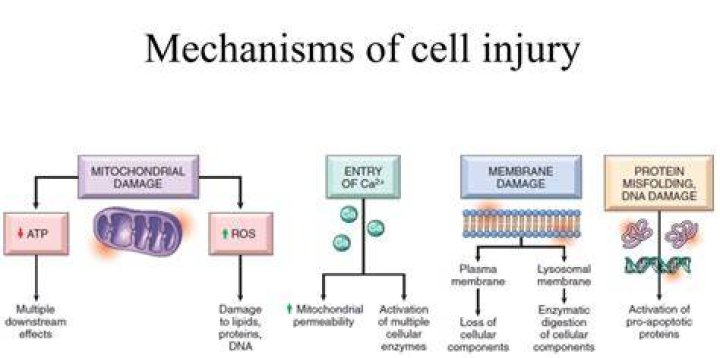
 Andrew Ramirez