What is the Family Educational Rights and Privacy Act of 1974?
 Matthew Sanders
 .
In this way, what is the Family Educational Rights and Privacy Act of 1974 Ferpa )?
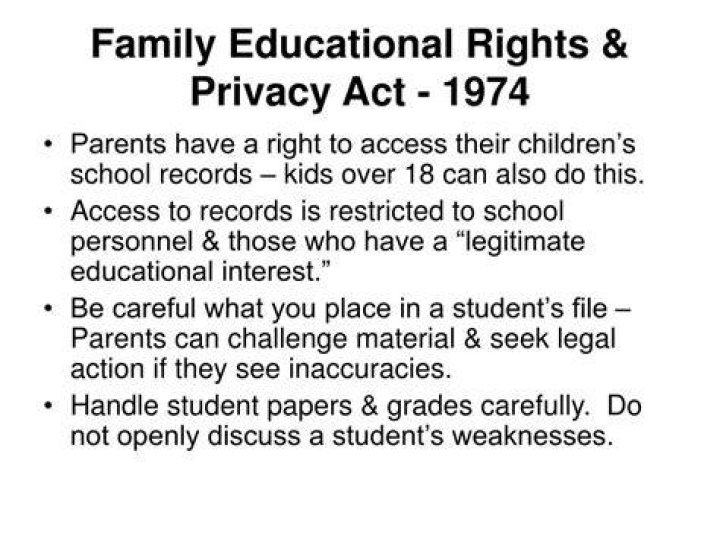
The Family Educational Rights and Privacy Act (FERPA) (20 U.S.C. § 1232g; 34 CFR Part 99) is a Federal law that protects the privacy of student education records. The law applies to all schools that receive funds under an applicable program of the U.S. Department of Education. Schools may charge a fee for copies.
Additionally, what are parents rights under Ferpa? The Family Educational Rights and Privacy Act (FERPA) is a federal law that affords parents the right to have access to their children's education records, the right to seek to have the records amended, and the right to have some control over the disclosure of personally identifiable information from the education
In this regard, why was the Family Educational Rights and Privacy Act 1974 created?
It was out of this public outcry that the Family Educational Rights and Privacy Act also known as FERPA, was born. FERPA sought to limit access to student educational records and protect the privacy of student academic and personal information.
What is covered by Ferpa?
FERPA classifies protected information into three categories: educational information, personally identifiable information, and directory information. The limitations imposed by FERPA vary with respect to each category.
Related Question Answers
Should I waive the Family Educational Rights and Privacy Act of 1974?
Under the Family Educational Rights and Privacy Act (FERPA) of 1974, enrolled students have access to educational records concerning them. If you waive this right, that means you agree that you will not be allowed access to this particular item (the letter of reference) in your record.What three laws protect confidentiality?
In the United States, three laws have been enacted to uphold student privacy and data security: the Family Education Rights & Privacy Act (FERPA), the Children's Online Privacy Protection Act (COPPA), and the Children's Internet Protection Act (CIPA).What are Ferpa violations?
If a school denies access to student records to a parent of a student under the age of 18, that's a FERPA violation, Rooker points out. It's also a violation to deny the student access to his own records (provided the student is at least 18 or is enrolled in a postsecondary institution).Can a principal question a child without a parent?
Police can question a child without a parent present and are not required to obtain permission from a parent before questioning the child. However, if a parent is present when the police approach the child or police ask permission in advance, a parent can refuse to allow the child to be interviewed.What type of law is the Family Educational Rights and Privacy Act Ferpa?
The Family Educational Rights and Privacy Act of 1974 (FERPA or the Buckley Amendment) is a United States federal law that governs the access to educational information and records by public entities such as potential employers, publicly funded educational institutions, and foreign governments.What are my Ferpa rights?
The Family Educational Rights and Privacy Act (FERPA) is a federal law that affords parents the right to have access to their children's education records, the right to seek to have the records amended, and the right to have some control over the disclosure of personally identifiable information from the educationWhat are my rights as a parent in the school system?
With that caveat, then, parents with children in public schools usually have the right to: Expect and request an educational environment that is emotionally and physically safe for their children. Expect and request an educational environment that respects their family's and their child's religious freedoms.What rights should students have in school?
The Rights We Should Have- Right to Free Public Education.
- Right to Study Curriculum that Acknowledges & Addresses Youth's Material and Cultural Needs.
- Right to Safe & Secure Housing.
- Right to Free Public Transportation.
- Right to Physical Activity & Recreation.
- Right to Safe & Secure Public Schools.
- Right to Free Health Care.
- Right to High Quality Food.
Who can access student records under Ferpa?
If you are age 18 or over or enrolled in a postsecondary institution (an “eligible student”), then you have a right to view your own education records. Under FERPA, a parent includes any natural parent, guardian, or individual (such as a foster parent) acting as parent in the absence of a parent or guardian.Can school records be released without parental consent?
Generally, schools must have written permission from the parent or eligible student in order to release any information from a student's education record. However, FERPA allows schools to disclose those records, without consent, to the following parties or under the following conditions (34 CFR § 99.31):Why is Ferpa so important?
FERPA is an important law originally intended to protect student and parent privacy. It is the cornerstone of education privacy, and knowing its key provisions it is a must in order to understand current educational privacy rights for students and parents. The FERPA law as written is very simple.Is an IEP confidential?
The IEP is a confidential document; use discretion when disseminating any information contained in an IEP. Consult with the principal and teachers involved in the student's program as often as necessary.Who governs Ferpa?
FERPA is a Federal law that is administered by the Family Policy Compliance Office (Office) in the U.S. Department of Education (Department). 20 U.S.C. § 1232g; 34 CFR Part 99.What is the Ferpa waiver?
The FERPA waiver only waives your right to access your recommendation letters after you've been accepted to and enrolled in a college. It's common practice for recommendation letters to be kept confidential in admissions procedures. The FERPA waiver is probably the easiest part of your application.Do private schools follow Ferpa?
FERPA applies to educational agencies and institutions (e.g., schools) that receive funding under any program administered by the Department. Private and parochial schools at the elementary and secondary levels generally do not receive such funding and are, therefore, not subject to FERPA.When did Ferpa become law?
1974,
How do you comply with Ferpa?
4.Understand What Rights FERPA Provides- Exercise their right to review records.
- Exercise their right to correct information.
- Refuse disclosure of directory information.
- Consent to the disclosure of PII.
- File a complaint about FERPA violations.