What is a markup in math?
 Lily Fisher
 .
Keeping this in consideration, what is the definition of markup in math?
Markup. How much a retailer increases the price over what they paid for it (which is how they make money to pay for all their costs and hopefully make a profit). Shown as an amount, or as a percentage of the price the retailer paid. Example: GoodSports buy soccer balls for $10.00 each and sell them for $14.50.
Additionally, how do you calculate a 20% markup? Multiply the original price by 0.2 to find the amount of a 20 percent markup, or multiply it by 1.2 to find the total price (including markup). If you have the final price (including markup) and want to know what the original price was, divide by 1.2.
Subsequently, question is, how do you find the markup?
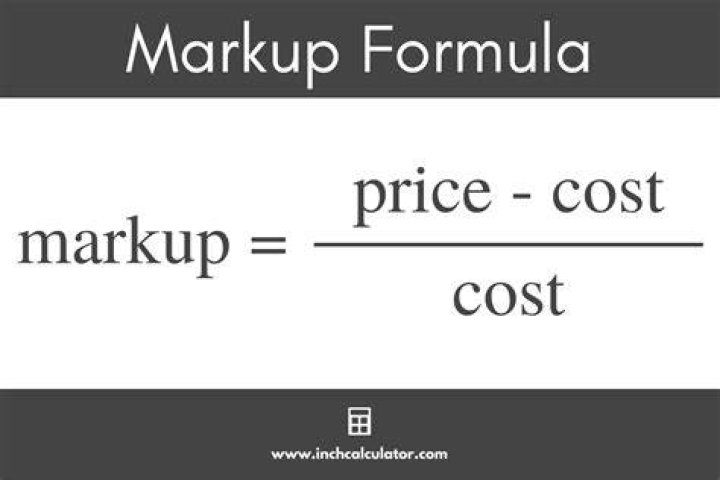
To calculate the markup amount, use the formula: markup = gross profit/wholesale cost. If you know the wholesale cost and the markup percentage, then calculating the gross profit just involves multiplying those two numbers. To get to the final retail sticker price, add the gross profit to the original, wholesale cost.
What is markup and markdown in math?
Markup is how much to increase prices and markdown is how much to decrease prices. Then we find the markup percentage by dividing the difference by the cost to produce them. If we are given a markup percentage, we multiply the percentage with the cost to produce the item.
Related Question Answers
What is a 100% markup?
For a 100% markup, you raise the price by the cost, or by $100. Then, you sell the product for $200, or $100 more than its cost. This is what the 100% markup looks like: Cost of Product = $100.Is markup the same as profit?
Markup and profit are not the same! Terminology speaking, markup is the gross profit percentage on cost prices or cost of goods sold, while margin is the gross profit percentage on selling price or sales.What's the difference between markup and margin?
The difference between margin and markup is that margin is sales minus the cost of goods sold, while markup is the the amount by which the cost of a product is increased in order to derive the selling price. Margin (also known as gross margin) is sales minus the cost of goods sold.What is another word for markup?
Synonyms. lucre net income profits profit net net profit earnings. Antonyms. lose disadvantage unprofitableness unprofitability gross. Trending Searches ??How do you determine a price for your product?
One of the most simple ways to price your product is called cost-plus pricing. Cost-based pricing involves calculating the total costs it takes to make your product, then adding a percentage markup to determine the final price.
Cost-Based Pricing
- Material costs = $20.
- Labor costs = $10.
- Overhead = $8.
- Total Costs = $38.
What is a good markup percentage?
a reasonable profit margin and yet low enough to keep your merchandise affordable and competitive. Even though there is no hard and fast rule for pricing merchandise, most retailers use a 50 percent markup, known in the trade as keystone.Is Mark up one word or two?
The verbal expression is to mark up (two words) (like "setup" and "set up") No hypnen.How do you calculate a 40% markup?
For example if your cost is $10.00 and you wish to markup that price by 40%, 100% + 40% = 140%. Multiply the $10.00 cost by 140% and get the retail price of $14.00.What is markup pricing with example?
Markup is the difference between a product's selling price and cost as a percentage of the cost. For example, if a product sells for $125 and costs $100, the additional price increase is ($125 – $100) / $100) x 100 = 25%.What is markup pricing strategy?
Markup pricing or cost-plus pricing is a pricing strategy where the price of a product or service is calculated by adding together the cost of the products and a percentage of it as a markup. The percentage or markup is decided by the company usually fixed at the required rate of return.How do we calculate profit percentage?
How to calculate profit margin- Determine the net income (subtract the total expenses from the revenue).
- Divide the net income by the revenue.
- Multiply the result by 100 to arrive at a percentage.