What did Antoine Lavoisier discover?
 Emily Dawson
 .
Regarding this, what did Antoine Lavoisier discover about the atom?
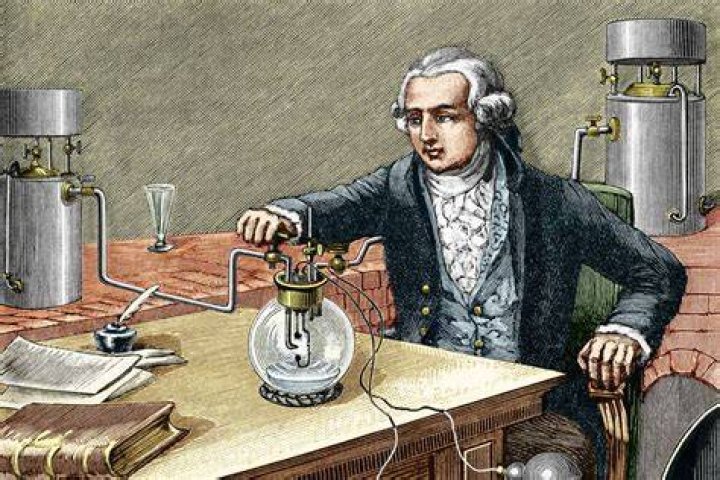
Antoine Lavoisier (1743-1794) was the first person to make good use of the balance. He was an excellent experimenter. After a visit with Priestly in 1774, he began careful study of the burning process. He proposed the Combustion Theory which was based on sound mass measurements.
Also, how did Antoine Lavoisier discover oxygen? In 1779 Lavoisier coined the name oxygen for the element released by mercury oxide. He found oxygen made up 20 percent of air and was vital for combustion and respiration. He also concluded that when phosphorus or sulfur are burned in air, the products are formed by the reaction of these elements with oxygen.
People also ask, what is Antoine Lavoisier famous for?
Lavoisier is most noted for his discovery of the role oxygen plays in combustion. He recognized and named oxygen (1778) and hydrogen (1783), and opposed the phlogiston theory. Lavoisier helped construct the metric system, wrote the first extensive list of elements, and helped to reform chemical nomenclature.
What big discoveries in chemistry is Lavoisier responsible for?
Antoine-Laurent Lavoisier, a meticulous experimenter, revolutionized chemistry. He established the law of conservation of mass, determined that combustion and respiration are caused by chemical reactions with what he named “oxygen,” and helped systematize chemical nomenclature, among many other accomplishments.
Related Question Answers
Who discovered the proton?
Rutherford
How did Antoine Lavoisier discover the law of conservation of mass?
Lavoisier placed some mercury in a jar, sealed the jar, and recorded the total mass of the setup. He found in all cases that the mass of the reactants is equal to the mass of the products. His conclusion, called the states that in a chemical reaction, atoms are neither created nor destroyed.Who discovered the nucleus?
Ernest Rutherford
Who invented chemical reactions?
Antoine Lavoisier
When did Aristotle discover his atomic theory?
450 B.C. Aristotle did not believe in the atomic theory and he taught so otherwise. He thought that all materials on Earth were not made of atoms, but of the four elements, Earth, Fire, Water, and Air. He believed all substances were made of small amounts of these four elements of matter.What is the theory of combustion?
The prevailing theory was that flammable materials contained a substance called “phlogiston” (from the Greek word for burn) that was released during combustion. The theory held that when a candle burned, for example, phlogiston was transferred from it to the surrounding air.When did Antoine Lavoisier discover the atomic theory?
The first breakthrough in the study of chemical reactions resulted from the work of the French chemist Antoine Lavoisier between 1772 and 1794. Lavoisier found that mass is conserved in a chemical reaction.What was Dalton's model of the atom?
Dalton's model of the atom (ESAAO)John Dalton proposed that all matter is composed of very small things which he called atoms. This was not a completely new concept as the ancient Greeks (notably Democritus) had proposed that all matter is composed of small, indivisible (cannot be divided) objects.Why is Antoine Lavoisier considered the father of chemistry?
Antoine Lavoisier determined that oxygen was a key substance in combustion, and he gave the element its name. He developed the modern system of naming chemical substances and has been called the “father of modern chemistry” for his emphasis on careful experimentation.Who discovered oxygen first?
Joseph PriestleyAntoine LavoisierCarl Wilhelm ScheeleWhat is the most famous Calx formed from iron?
Lavoisier concluded the formation of rust (iron calx) was due to something from the water mixing with the iron bar. He knew that oxygen ignited in hydrogen formed water. His experiment suggested that the water could be split into hydrogen (collected as a gas) and oxygen (that mixes with the iron causing rust).Why is the phlogiston theory wrong?
It was Antoine Lavoisier who disproved the Phlogiston Theory. He renamed the "dephlogisticated air" oxygen when he realized that the oxygen was the part of air that combines with substances as they burn. Because of Lavoisier's work, Lavoisier is now called the "Father of Modern Chemistry".What was the phlogiston theory of burning?
The phlogiston theory is a superseded scientific theory that postulated that a fire-like element called phlogiston (/fl?ˈd??st?n, flo?-, -?n/) is contained within combustible bodies and released during combustion. The name comes from the Ancient Greek φλογιστόν phlogistón (burning up), from φλόξ phlóx (flame).How do you use the law of conservation of mass?
Key Points- The law of conservation of mass states that mass in an isolated system is neither created nor destroyed by chemical reactions or physical transformations.
- According to the law of conservation of mass, the mass of the products in a chemical reaction must equal the mass of the reactants.
What is oxygen theory of combustion?
The oxygen theory of combustion resulted from a demanding and sustained campaign to construct an experimentally grounded chemical theory of combustion, respiration, and calcination. The phlogiston theory did not account for these weight changes, for fire itself could not be isolated and weighed.What was Lavoisier's hypothesis?
Lavoisier's hypothesis was that combustion and respiration were one and the same, and combustion occurs with every instance of respiration. Working with Pierre-Simon Laplace, Lavoisier designed an ice calorimeter apparatus for measuring the amount of heat given off during combustion or respiration.Why was Antoine Lavoisier killed?
As the Reign of Terror heated up, he used the Revolution to attack Lavoisier. Marat had done his damage before Charlotte Corday stabbed him to death in his bath. The Revolution finally arrested Lavoisier and sent him to the guillotine. Before the arrest, Lavoisier wrote to his friend Ben Franklin.Who is John Dalton and what did he discover?
John Dalton FRS (/ˈd?ːlt?n/; 6 September 1766 – 27 July 1844) was an English chemist, physicist, and meteorologist. He is best known for introducing the atomic theory into chemistry, and for his research into colour blindness, sometimes referred to as Daltonism in his honour.Where did Lavoisier live?
Paris