What causes brittle deformation?
 James Craig
 .
Likewise, people ask, what is brittle deformation?
Rocks along active plate boundaries are subjected to physical stress. When a rock breaks, it is called brittle deformation. Any material that breaks into pieces exhibits brittle behavior. When rocks bend or flow, like clay, it is called ductile deformation.
Also, what causes deformation? Deformation is caused by stress, the scientific term for force applied to a certain area. Stresses on rocks can stem from various sources, such as changes in temperature or moisture, shifts in the Earth's plates, sediment buildup or even gravity.
Similarly one may ask, where does brittle deformation occur?
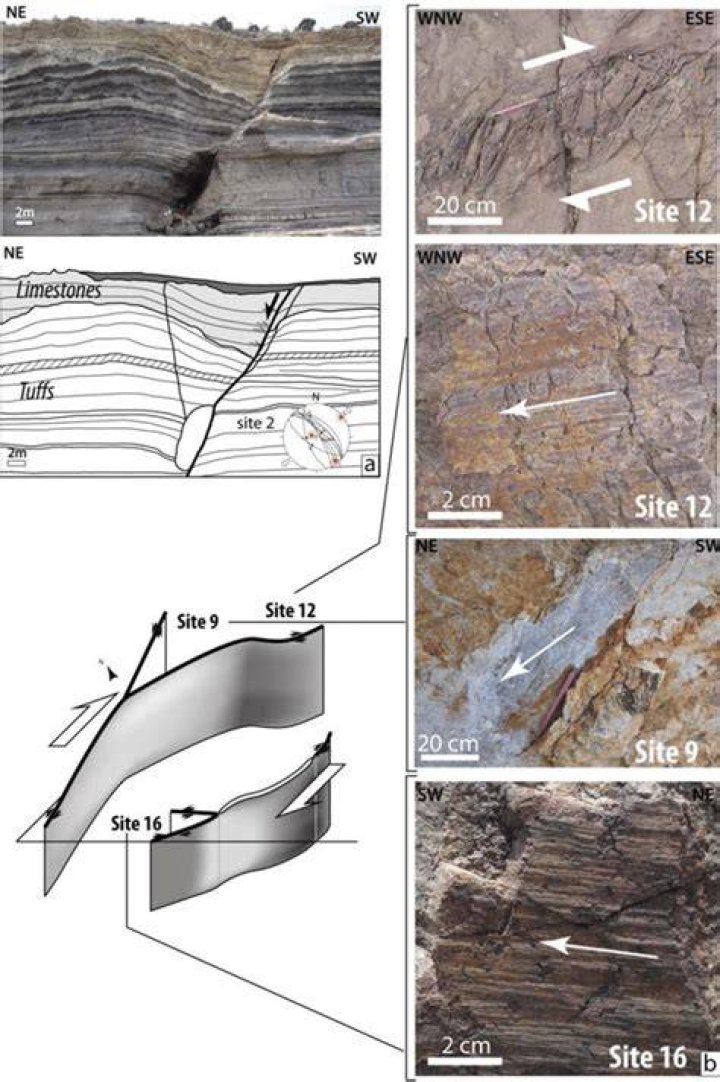
Brittle deformation may occur as a joint (also known as a crack or tensile fracture) in which no displacement occurs along the surface of discontinuity, or as a fault in which displacement does occur. 'Shear fracture' is used to imply a small displacement resulting from the initial formation of the fracture.
What structures form as a result of brittle deformation?
When rocks deform in a ductile manner, instead of fracturing to form faults or joints, they may bend or fold, and the resulting structures are called folds. Folds result from compressional stresses or shear stresses acting over considerable time.
Related Question Answers
What are the different types of deformation?
Types of deformation- Elastic deformation.
- True stress and strain.
- Plastic deformation.
- Fracture.
Is brittle deformation permanent?
It changes shape by a very small amount in response to the stress, but the deformation is not permanent. brittle deformation: Near the Earth's surface rock behaves in its familiar brittle fashion.What do you mean by deformation?
deformation. Change in the shape of a body caused by the application of a force (stress). Deformation is proportional to the stress applied within the elastic limits of the material. Sometimes things can happen in a factory that will cause a deformation and you will need to get it fixed quickly.What are the three types of stress for rocks?
Stress is the force applied to a rock, which may cause deformation. The three main types of stress go along with the three types of plate boundaries: compression is common at convergent boundaries, tension at divergent boundaries, and shear at transform boundaries.Which conditions in Earth will favor brittle failure of rocks?
-Temp: materials are brittle at low temps and ductile at high temps. The higher the temp, the more likely ductile behavior will occur and there will be deformation without fracture. The lower the temp, the more brittle the rock is and deformation will occur by fracture.What is the difference between elastic deformation ductile deformation and brittle deformation?
In elastic deformation, strain is recovered when stress is removed, but in brittle deformation, the object fractures. Ductile rocks have a failure point that is much higher than the yield strength, and so can accommodate permanent strain before failure.What is brittle material?
A material is brittle if, when subjected to stress, it breaks without significant deformation (strain). Brittle materials absorb relatively little energy prior to fracture, even those of high strength. Breaking is often accompanied by a snapping sound.What causes rocks to fold?
The folds arise as a result of the tectonic pressure and stress in the rocks and rather than fracture, they fold. They are easily visualized by the loss of horizontality of the strata. When tectonic forces acting on sedimentary rocks are a number of characteristic forms.What is the difference between brittle and ductile deformation quizlet?
Brittle deformation is where rock fractures once its strength is surpassed, while ductile deformation is where a rocks size and shape changes without fracturing. Shear stress causes a rock to be distorted. Confining stress squeezes rock causing it to fold or fracture.What is the difference between stress and strain?
The basic difference between stress and strain is that stress is the deforming force per unit area. Its unit is the same as pressure which is N/m²,While strain is the apparent change in the shape, volume or length of object caused due to stress is called strain. Strain has no unit.What type of deformation is associated with earthquakes?
Most natural earthquakes are caused by sudden slippage along a fault zone. The elastic rebound theory suggests that if slippage along a fault is hindered such that elastic strain energy builds up in the deforming rocks on either side of the fault, when the slippage does occur, the energy released causes an earthquake.What are the factors that determine how a rock will deform?
Once the elastic limit or strength of a rock is surpassed, it either flows or fractures. The factors that influence the strength of a rock and how it will deform include temperature, confining pressure, rock type, and time. Rocks deform permanently in two ways: brittle deformation and ductile deformation.Are faults brittle or ductile?
In the brittle layer the fault is assumed to have stick–slip behaviour, whereas the lower ductile crust is inferred to deform in a steady-state shear. Therefore, the brittle–ductile transition (BDT) separates two layers with different strain rates and structural styles.What is ductile and brittle behavior?
Ductile materials are materials that can be plastically twisted with no crack. They have the tendency to hold the deformation that occurs in the plastic region. Common ductile materials are copper, aluminum, and steel. Brittle material. A brittle material is one that will break as opposed to bending.What are the reasons why some zones of deformation are wider than others?
In brittle shear zones, the deformation is concentrated in a narrow fracture surface separating the wall rocks, whereas in a ductile shear zone the deformation is spread out through a wider zone, the deformation state varying continuously from wall to wall.What are the three common fault types quizlet?
Terms in this set (3)- Normal Fault. an inclined fault in which the hanging wall appears to have slipped downward relative to the footwall.
- Reverse Fault. a type of fault where the hanging wall slides upward; caused by compression in the crust.
- Strike Slip Fault.