Biosynthetic expansion. The genetic code grew from a simpler earlier code through a process of "biosynthetic expansion". Primordial life "discovered" new amino acids (for example, as by-products of metabolism) and later incorporated some of these into the machinery of genetic coding..
In respect to this, who created the genetic code?
The deciphering of the genetic code was accomplished by American biochemists Marshall W. Nirenberg, Robert W. Holley, and Har Gobind Khorana in the early 1960s.
One may also ask, why is the genetic code important? The genetic code is (nearly) universal Even in organisms that don't use the "standard" code, the differences are relatively small, such as a change in the amino acid encoded by a particular codon. A genetic code shared by diverse organisms provides important evidence for the common origin of life on Earth.
Considering this, what forms the genetic code?
Genetic code is the term we use for the way that the four bases of DNA--the A, C, G, and Ts--are strung together in a way that the cellular machinery, the ribosome, can read them and turn them into a protein. In the genetic code, each three nucleotides in a row count as a triplet and code for a single amino acid.
Where is the genetic code found?
The Genetic Code is stored on one of the two strands of a DNA molecules as a linear, non-overlapping sequence of the nitrogenous bases Adenine (A), Guanine (G), Cytosine (C) and Thymine (T). These are the "alphabet" of letters that are used to write the "code words".
Related Question Answers
What is DNA made of?
DNA is made of chemical building blocks called nucleotides. These building blocks are made of three parts: a phosphate group, a sugar group and one of four types of nitrogen bases. To form a strand of DNA, nucleotides are linked into chains, with the phosphate and sugar groups alternating.How long is genetic code?
DNA consists of a code language comprising four letters which make up what are known as codons, or words, each three letters long.Who discovered DNA?
Many people believe that American biologist James Watson and English physicist Francis Crick discovered DNA in the 1950s. In reality, this is not the case. Rather, DNA was first identified in the late 1860s by Swiss chemist Friedrich Miescher.Is genetic code universal?
Although each codon is specific for only one amino acid (or one stop signal), the genetic code is described as degenerate, or redundant, because a single amino acid may be coded for by more than one codon. Furthermore, the genetic code is nearly universal, with only rare variations reported.How many codons are in a gene?
64
What is a universal genetic code?
The universal genetic code is a common language for almost all organisms to translate nucleotide sequences of deoxyribonucleic acid (DNA) and ribonucleic acid (RNA) to amino acid sequences of proteins. Nonuniversal genetic codes are found in some organisms and organelles.How many genes do humans have?
There are an estimated 20,000-25,000 human protein-coding genes. The estimate of the number of human genes has been repeatedly revised down from initial predictions of 100,000 or more as genome sequence quality and gene finding methods have improved, and could continue to drop further.How many stop codons are there?
3 STOP codons
How many genetic codes are there?
The genetic code is highly similar among all organisms and can be expressed in a simple table with 64 entries. The code defines how codons specify which amino acid will be added next during protein synthesis. With some exceptions, a three-nucleotide codon in a nucleic acid sequence specifies a single amino acid.What are the 3 stop codons?
Stop codons are sequences of DNA and RNA that are needed to stop translation or the making of proteins by stringing amino acids together. There are three RNA stop codons: UAG, UAA, and UGA. In DNA, the uracil (U) is replaced by thymine (T).How does genetic work?
The DNA in a gene spells out specific instructions—much like in a cookbook recipe — for making proteins (say: PRO-teens) in the cell. Like chromosomes, genes also come in pairs. Each of your parents has two copies of each of their genes, and each parent passes along just one copy to make up the genes you have.What are codons and Anticodons?
A codon is found on the coding strand of double-stranded DNA and in the (single-stranded) mRNA. The anticodon is found on the tRNA and is the part that base-pairs with the codon (on the mRNA) in order to bring the appropriate amino acid to the ribosome to be added to the growing peptide chain.What are proteins made of?
Proteins are made up of smaller building blocks called amino acids, joined together in chains. There are 20 different amino acids. Some proteins are just a few amino acids long, while others are made up of several thousands. These chains of amino acids fold up in complex ways, giving each protein a unique 3D shape.What are the Anticodons?
Anticodon Definition. Anticodons are sequences of nucleotides that are complementary to codons. They are found in tRNAs, and allow the tRNAs to bring the correct amino acid in line with an mRNA during protein production.Is genetic code overlapping?
The genetic code is composed of nucleotide triplets. In other words, three nucleotides in mRNA (a codon) specify one amino acid in a protein. The code is non-overlapping. This means that successive triplets are read in order.What are the properties of genetic code?
The eight important properties of genetic code are: (1) Code is a Triplet (2) The Code is Degenerate (3) The Code is Non-overlapping (4) The Code is Comma Less (5) The Code is Unambiguous (6) The Code is Universal (7) Co-linearity and (8) Gene-polypeptide Parity.What is code degeneracy?
Degeneracy of codons is the redundancy of the genetic code, exhibited as the multiplicity of three-base pair codon combinations that specify an amino acid. The degeneracy of the genetic code is what accounts for the existence of synonymous mutations.What do the letters DNA stand for?
DNA. DNA stands for deoxyribonucleic acid, sometimes called "the molecule of life," as almost all organisms have their genetic material codified as DNA. Since each person's DNA is unique, "DNA typing" is a valuable tool in connecting suspects to crime scenes. 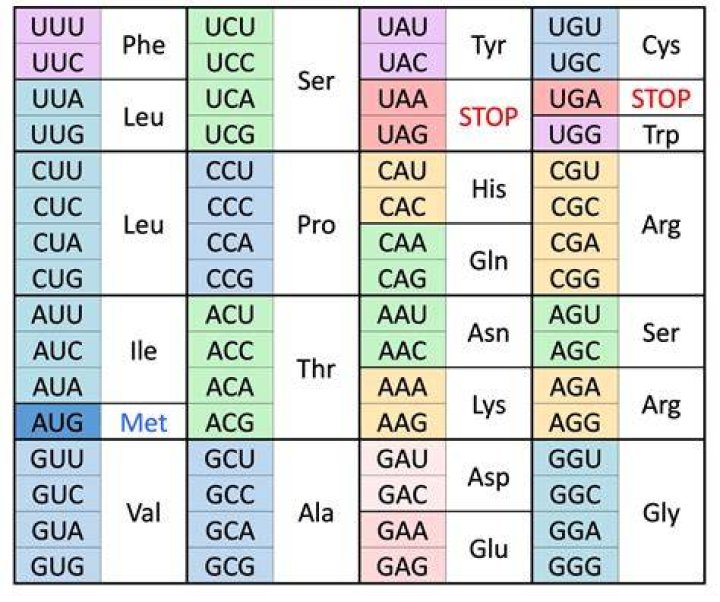
 David Mack